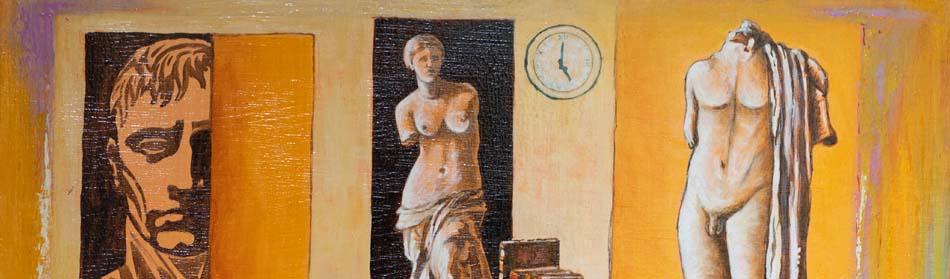
Francesco Rodi is a formidable
creator of forms and images, he paints with the skilful dexterity of the masters
of the past, with the illuminating intuitions of the precursor, leaning towards
a new iconology that reinterprets the ancient with the eye of the modern. In
this way, lost images come back to life, dreamlike adventures that are now an
integral part of the mnemonic and cultural heritage of peoples: a village
square, a street, dancing women, still lifes that magically take on the
dimension of myth, of legend in a continuous ignition of fantasies
and reality.
Roberto Bosco
Rodi offers us its world, its
things, its landscapes, its dancers, the village scenes taken from a distant
imagination. A reminder of a southern peasant world now at rest, lived in the
alleys and squares of sunny villages, full of history. Fruit, baskets, men's
faces, marines, boats, represent with great humility a history that is now past.
Through these images and values, Francesco seeks to build his history, far from
his homeland, in a country where the time composes and decomposes pictures that
sometimes we don't understand, they escape us, because perhaps they don't want
to communicate anything.
Vincenzo Varone
Francesco Rodi is without any
doubt one of those artists who can arouse and bring out the psychological
dynamics through his works. He arrived to this result after years of work, with
a creative effort and an evolutionary path that few are able to face and to
bring to fruition. Parallel to the evolutionary path he also developed a process
of refinement of his technical potential that has successfully brought him to
experiment with new ways of expression and assembly through the use of different
materials and with a more refined and delicate use of the color.
Domenico De Maio
There is in
Francesco Rodi a univocal love, without fractures, made of limpid enthusiasm and
willing to trace the substance of being through connotations of elegance and
strength. For this reason, for example, his dancers, his landscapes, his naked
objects are charged and illuminated with a harmonious, non-overflowing light
that is so reminiscent of that of the artists of the so-called Roman School.
Roberto Bosco
The journey becomes an opportunity to explore the different facets of the soul
and as you wander, you find yourself. The roof, a metaphor for a safe place to
shelter which is very often the armor we have built for ourselves, has burned.
Now we are ready, perhaps, to see in Selene what we are. We travel through
paths, on trams or ships, in the streets wet by rain or enclosed by impersonal
buildings; We land on islands, or in silent cities, or crouch on cozy sofas. We
travel with memory, with memories, with nostalgia, with the suffering of
detachment or the desire to return, but above all we travel to meet "the other",
whether it is the human race or ourselves.
It is the journey of the soul of Maestro Francesco Rodi.
Giuseppina Micheli
The artwork, as a whole, is for
the artist Rodi a sort of bridge between his inner world and the outer world,
and through symbolic expression transmits outside his ow n vision of life in the
knowledge that this can be communicated without the use of the word. He
conceives art not only as a research of aestheticism but as global expression of
life itself, and in his works we can find emotions, perceptions, memory,
imagination; everything generates in people observing them suggestions that
resonate with their own personal history, with the most intimate emotions and
desires awakening the deepest contents of the unconscious.
Domenico De Maio
In his new paintings there is a different air and the execution, even if
it shows continuity with the past, is now tending towards a concentration of
color and figure. The amenity of his brushstroke has become more energetic and
essential and he tries to "draw" a reality that wants to coincide at all costs
with the essence of his thought that seems to have taken on a particular
analytical and speculative force. The literary references are obvious and so are
the philosophical ones.
For example, in the "Journey" there is a clock and Einstein's face: the
meditation on time, space and relativism is not at all accidental. As for the
"Lost Identity": the man who looks at himself in the mirror can only be
"Moscarda", the protagonist of Pirandello's novel "One, No One and One Hundred
Thousand".
Roberto Bosco
The characters in his works are
part of the society in which we live, an expression of abandonment,
misunderstanding, isolation and rejection of oneself and others. The colors are
not immensely cold, they manage to give warm, serene tones and yet in that
semblance of serenity the state of melancholy, loneliness, estrangement is well
present. The figure is there: sometimes you can perceive its outline, other
times the matter, the physicality, but most of it is as if it did not have a
spiritual consistency (spirit as soul).
Giuseppina Micheli
When we met the master Francesco Rodi, in addition to the brilliant curriculum
that reports his countless exhibitions in Italy and abroad, what struck us most
was the simplicity of the man and the naturalness with which he presented us
with the exhibition "The Journey".
The theme of travel, both physical and metaphorical, has always inspired
artists, but the peculiarity of the 25 works on display at the Rocca Colonna do
not only represent Francesco Rodi's journey, but embody a universal exploration
of the human soul, a unique synthesis, which manages to blend universal feelings
with personal experiences, transporting us into a dreamlike dimension that
transcends subjectivity.